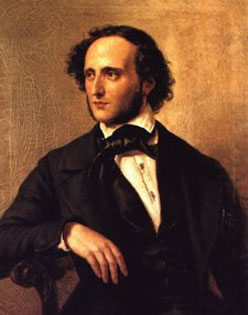
My curiosity was peaked whilst reading "The Youngest Master" by Alex Ross written for the New Yorker regarding the 200th birthday of composer Felix Mendelssohn. I was quite excited to read about a composer I am not completely familiar with (other than his body of work) written by someone whom I had always assumed was a semi-competent and knowledgeable writer on the subject. What I read instead was a brief, "Amadeus"-like outline for a hollywood movie script that dropped historical figures such as Goethe and especially Richard Wagner, who did in fact created quite a case against Mendelssohn and his music.
The anti-semetic Wagner was indeed partly responsible for the "suppression" of Mendelssohn's work (a well known fact), but the statement Mr. Ross makes concerning what he calls the "tortured relationship" between the two is simply trite. There is no historical evidence that Wagner ever "dreamed that his older collegue addressed him with du..." Mr. Ross is simply creating his own history in order to make his case that Mendelssohn was next to God.
This God-like admiration can also be taken from the end of Mr. Ross' third paragraph where he refers to Mendelssohn as "a musical Goethe". Mr. Ross is obviously a Goethe admirer as many people have been for generations, but this is unfortunately a failed attempt by Mr. Ross to appeal to another sect of know-it-alls within his circle of faux artists to explain Mendelssohn's prowess with the pen.
My previous knowledge of Mendelssohn's musical virtuosity had prepared me for the popular comparison to Mozart which are, by all accounts, completely out of touch with the art of music. Comparing the technical compositional ability of Mendelssohn to Mozart is like comparing apples and oranges: Two composers from different eras in time and artistic movement. If any comparison must be made, history will speak it: Mendelssohn will never be as revered a composer as Mozart if only due to the fact that Mozart was by all accounts a better composer and had a better understanding of his art, originality, and audience. Originality was not in the forefront of Mendelssohn's artistic process which could be one of many (if unfortunate) reasons his music is placed on a similar level to the likes of Franz Liszt and performed much more infrequently than the work of Mozart even post-Wagner.
My initial intrigue was as to whether or not Mr. Ross actually listens to the music about which he writes; or any music for that matter. Does he indeed have experience in using musical theory in practice or is he merely dropping vocabulary that he finds in conservatory text books, overhears at the superficial parties he attends, or pretends to comprehend at the concerts at which he falls asleep?
I have enjoyed many of Mr. Ross' articles in the past, but this one in particular left a bad taste in my mouth. Mendelssohn was indeed a master composer, but the treatment Mr. Ross gave to him in his article read like the New Testament. It is obvious that he places Mendelssohn on a very high pedestal, but is it at a deserving height in reality?
My little essay came mostly out of anger (I get quite emotional when it comes to music and especially concert music of which I have a pretty extensive knowledge). Mostly, I think I just wanted to prove to myself that I could still form a sentence and flex some sort of muscle at Mr. Ross' expense. The reality is that I still think Mr. Ross is an amazing writer with great appreciation for what he writes about and I will continue to read his shit.
Love,
Bill
Maestro


Sorry to be a pedant, but your curiosity was piqued.
ReplyDeleteDid you actually send this to the New Yorker? It's pretty scathing. Nice blog.
haha piqued. you're right. i am no writer by any means.
ReplyDeleteand:
ReplyDeletei did NOT send this to the new yorker because i knew it was a little scathing and the reality is that i think alex ross is great and didn't want to have any emotional hangovers about sending it.
emotional hangover :?)
ReplyDeletethanks, james
ReplyDelete