Many people would call Mr. Partch the "Father of Modern Microtonality" and I couldn't agree more. Partch created a 43 note per octave tuning system in the early 20th century (it began as 39 note per octave) to accommodate his compositional style which was far from the traditional Western Equal Temperament that was in use by even the most "avant garde" Western composers of the time. Do not misunderstand, as Partch was not at all attempting to be "avant garde", but rather contribute something to the world that contained not only originality, but an acknowledgment and respect towards the ideas and sounds of the ancient past (he was quite aware of the sounds of ancient Greece and China). His 43 note per octave tuning utilized the ideas of Just Intonation where frequencies are rounded (and tuned) to the nearest whole number ratio creating an effect that is closer to the natural physics of the harmonic series. The result tends to be a bit more consonant than some intervallic examples in equal temperament and other systems (see some of my previous posts for examples and other rants about tuning).
Partch's system may not have existed without his discovery of a book titled "On the Sensations of Tone" by Hermann Helmholtz. As an owner of the book I can assure you that, though being quite dense, is certainly your best bet to understanding where Partch gained most of his knowledge concerning Just Intonation.
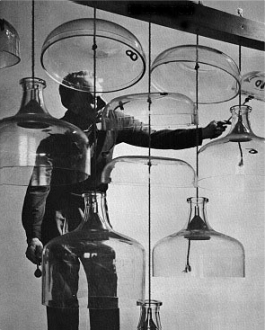
Rather than rant about how great Harry Partch is, below are two clips of a short documentary on Partch:
Also, if you would like to "play" some of Harry Partch's instruments, this Virtual Instrumentarium is quite fun and great for sampling.


No comments:
Post a Comment